The morning smog alert is really helpful before heading to morning lectures. Still has a few small glitches in the UI, but the basic alert works well.
Clinical Decision Support & Attack Prevention
Intelligent Respiratory Care
Before Airway Constriction Occurs
HridyaVayu bridges continuous environmental IoT telemetry with validated clinical guidelines (GINA) and collaborative machine learning to predict asthma exacerbations hours in advance.
Multimodal Collaborative AI
Combines Linear Regression, Random Forest, and Gradient Boosting to prevent single-model bias.
Live Meteorological Sync
Continuous GPS-anchored feed tracking AQI, PM2.5, NO2, and SO2 spikes.
GINA Safety Guardrails
Deterministic clinical heuristics prioritize emergency escalation for severe nocturnal symptoms.
Smart Inhaler Adherence
Canister level tracking, dose verification, and rapid emergency distress dispatch.
~83%
High-Risk Sensitivity
42.4%
Global Deaths in India
GINA
Deterministic Safety Guardrails
24-Hour
Proactive Telemetry Horizon
The Clinical Imperative
Why HridyaVayu? The Case, The Need & The Impact
Transforming conventional reactive asthma management into proactive, AI-guided attack prevention.
The Clinical Problem (The Need)
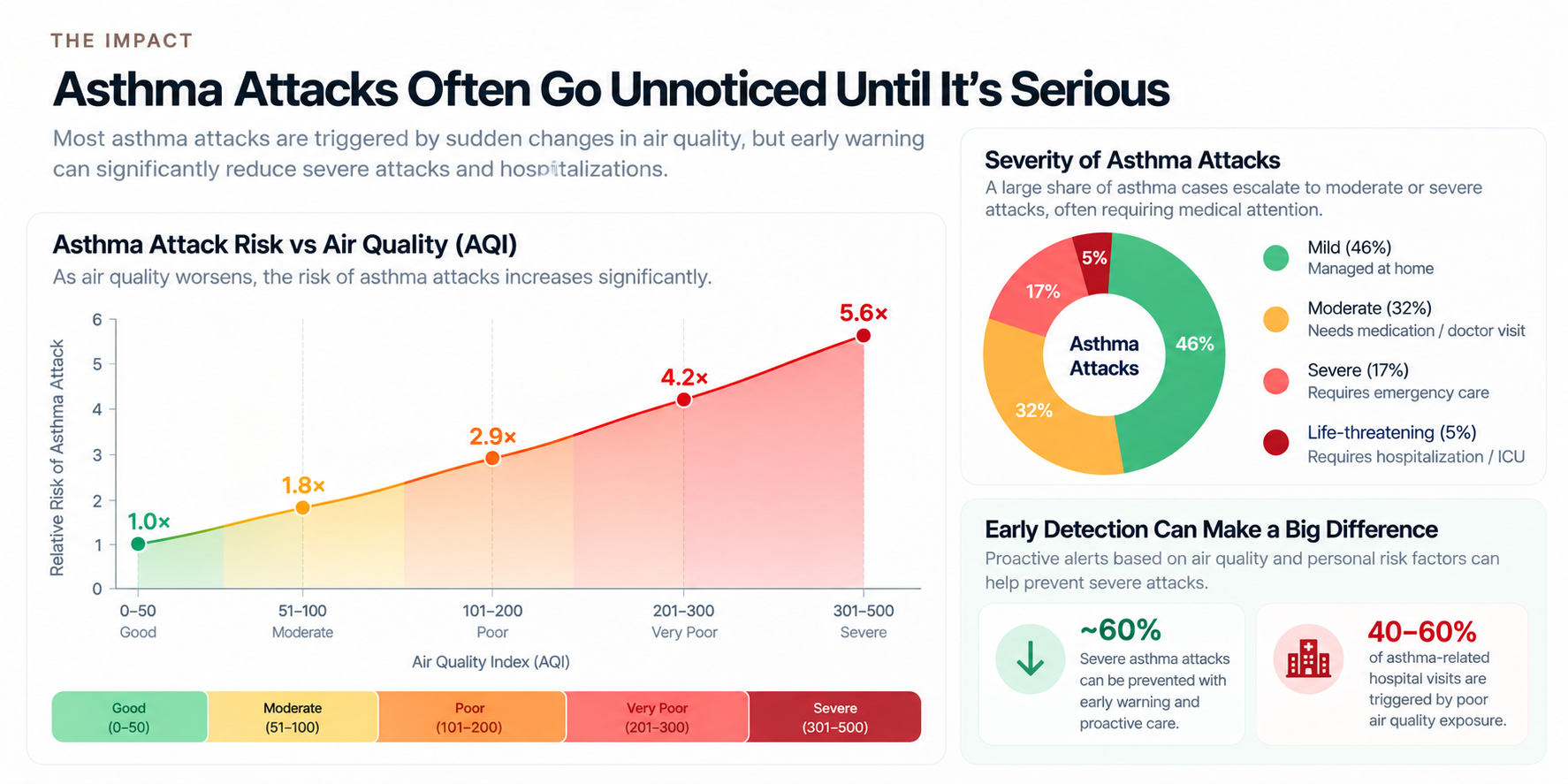
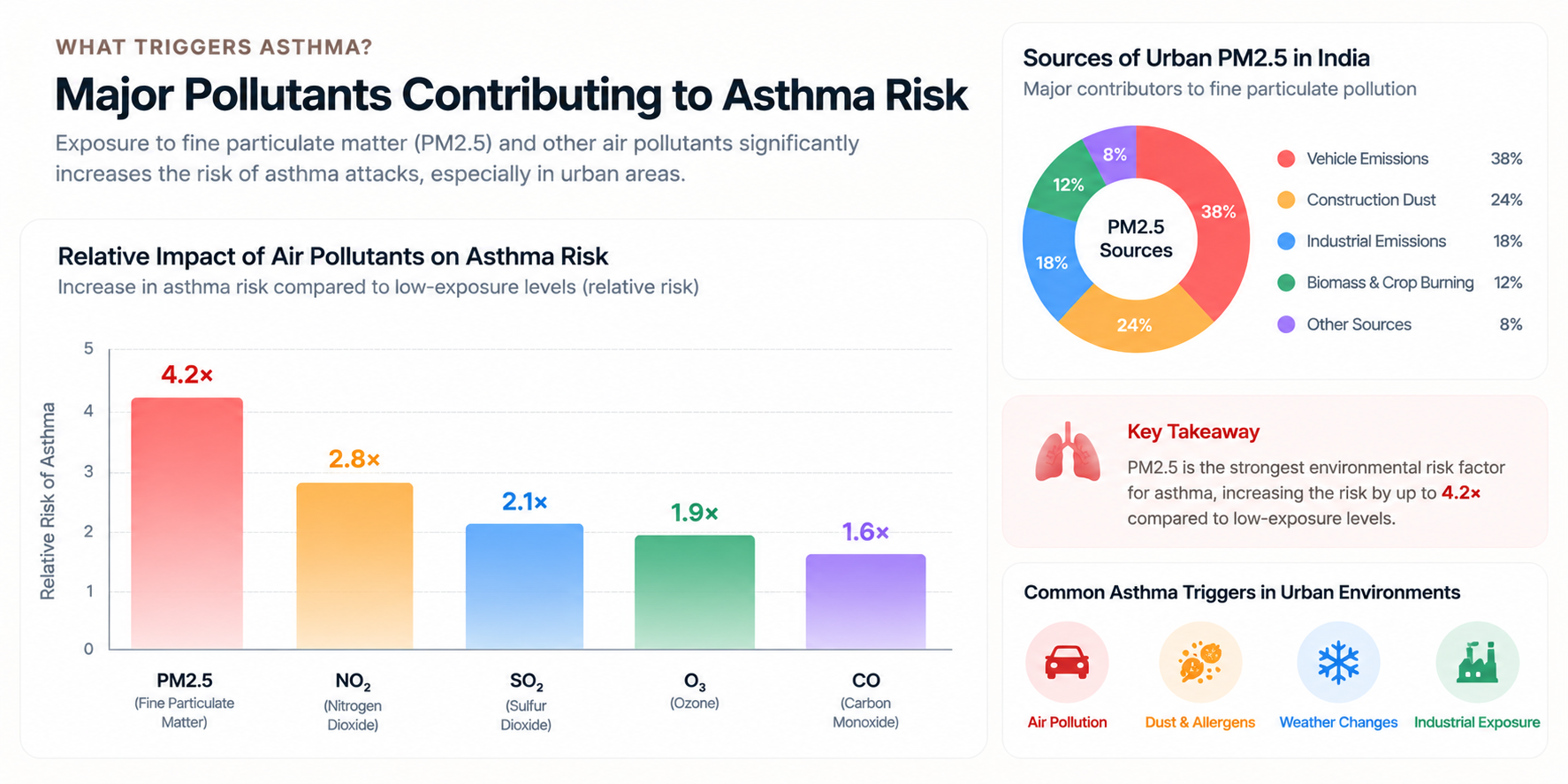
Over 300 million individuals globally suffer from chronic bronchial asthma. Clinical evidence reveals that over 80% of severe hospitalizations and acute attacks are triggered by undetected ambient air pollution spikes (PM2.5, NO2, SO2) interacting with hyper-reactive airways. Conventional asthma management is purely reactive—patients take medication only after airway constriction has already begun.
The HridyaVayu Breakthrough (The Case)
HridyaVayu bridges continuous satellite and ground-station IoT environmental telemetry with validated clinical guidelines (GINA criteria). By applying collaborative multimodal machine learning (combining Linear Regression, Random Forest, and Gradient Boosting), the system predicts elevated exacerbation risk hours before symptom onset, giving patients a critical preventive window.
The Patient & Physician Impact (The Benefits)
Patients receive personalized, actionable care directives, real-time smart inhaler canister tracking, and immediate emergency SOS dispatch during acute flare-ups. Clinicians gain objective, longitudinal population telemetry, verifiable medication adherence records, and calibrated risk scores backed by deterministic medical safety rails.
The Indian Epidemiological Emergency
India's Escalating Asthma Crisis & Urban Smog Reality
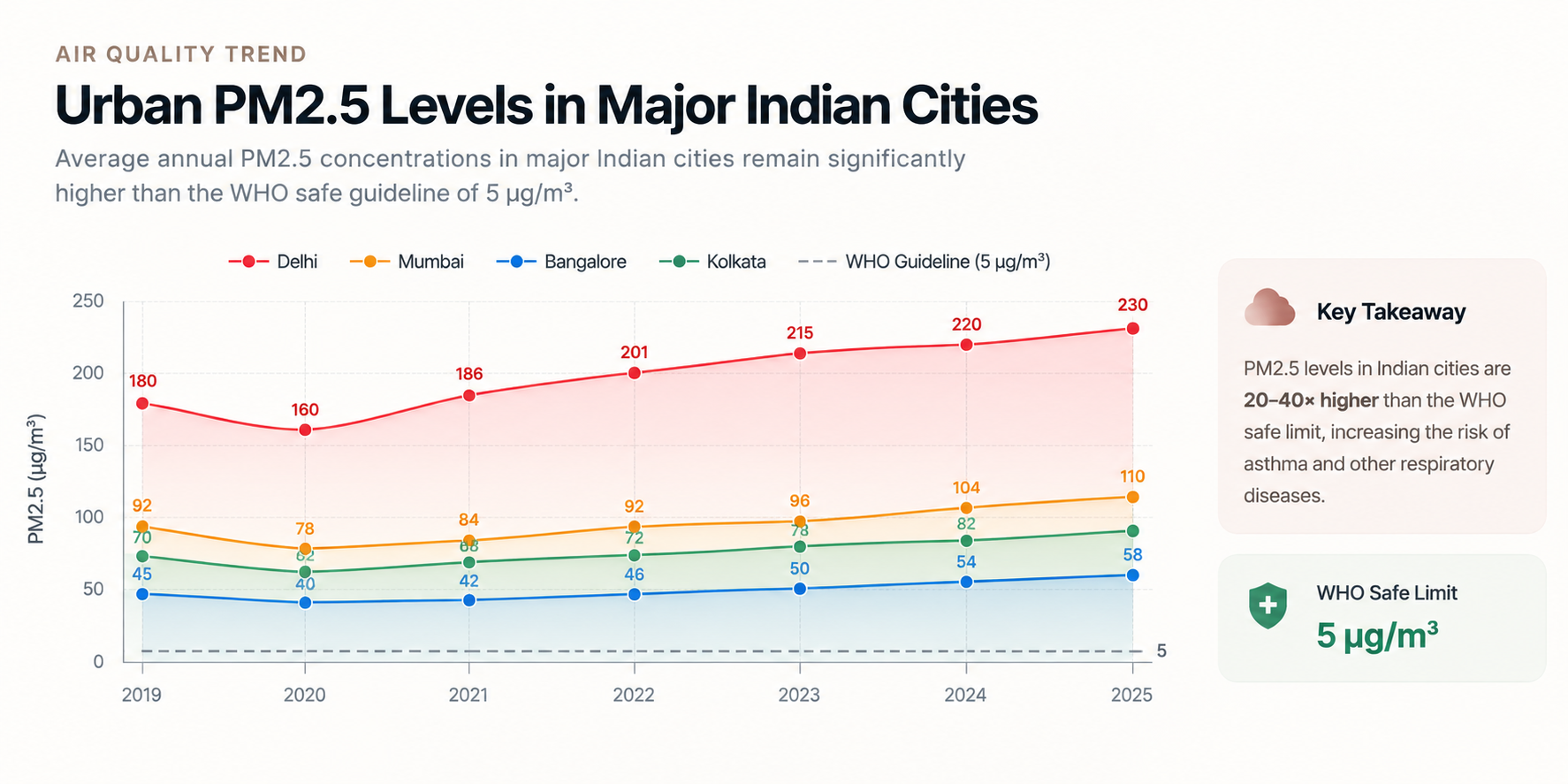
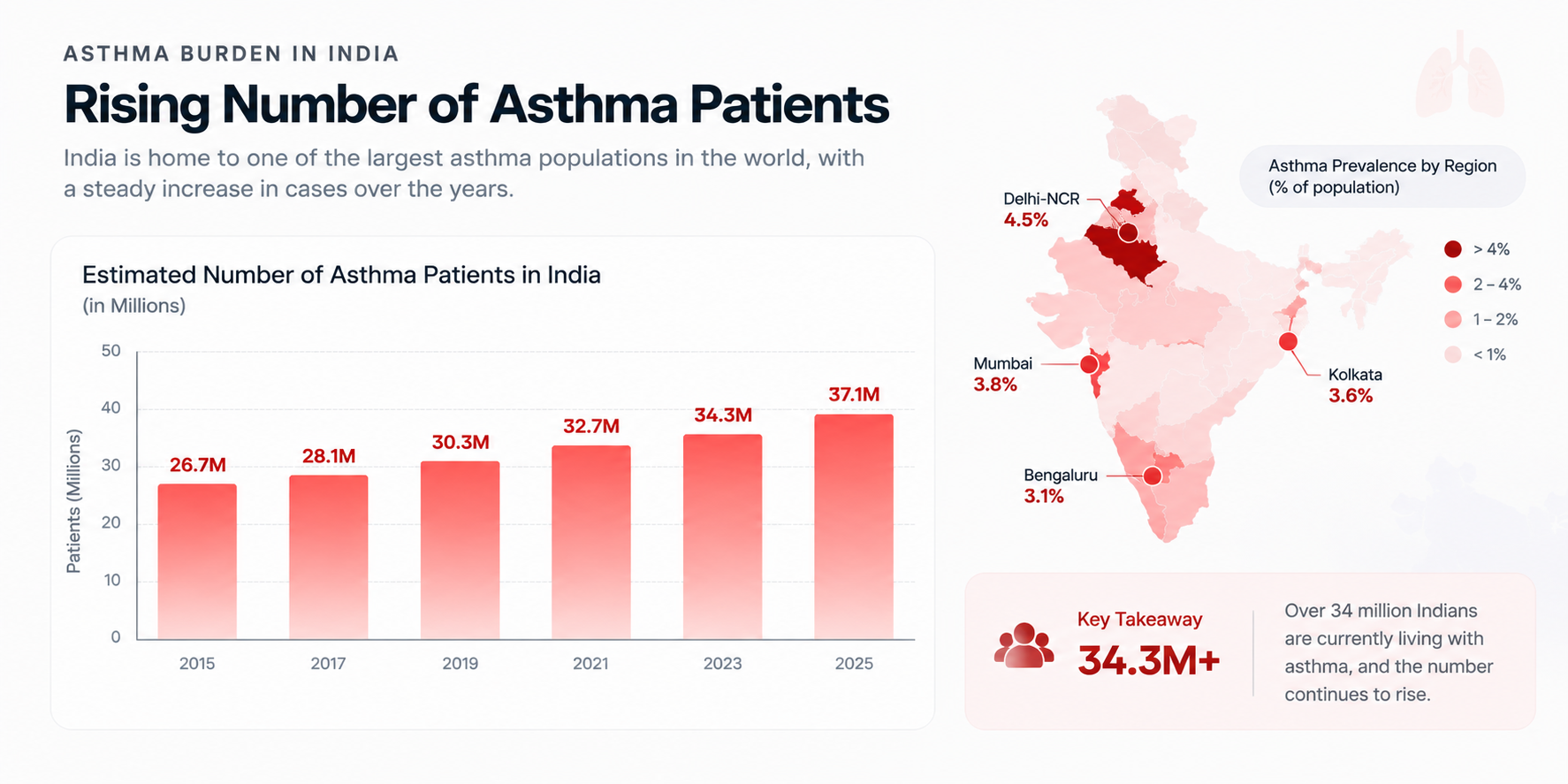
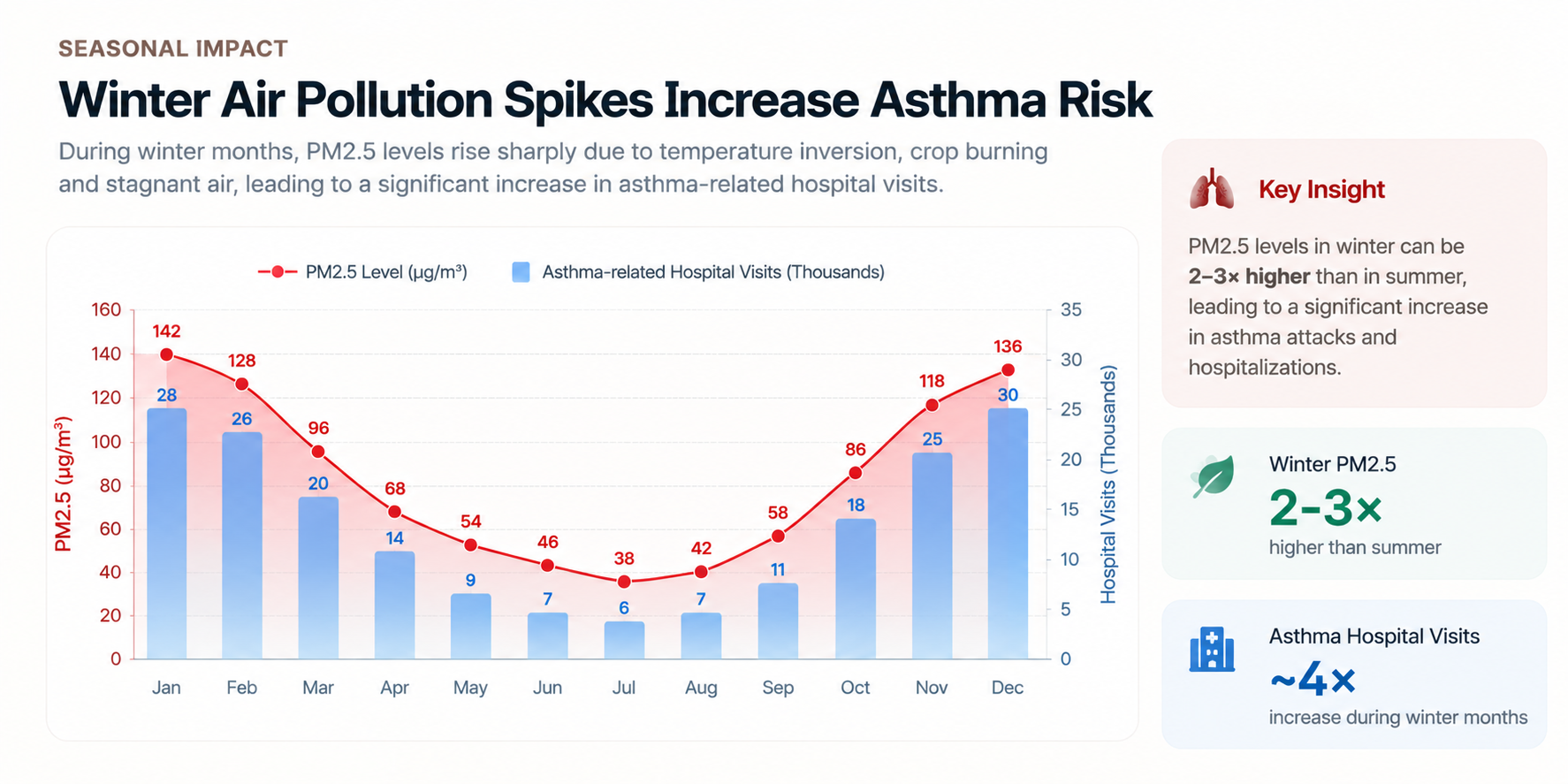
India represents the highest asthma fatality epicenter worldwide: according to The Lancet Global Health, India accounts for 42.4% of all global asthma deaths despite having only 11.1% of global cases. In Indian megacities (Delhi-NCR, Kanpur, Kolkata, Mumbai, Lucknow), winter ambient PM2.5 levels routinely cross 250 to 450+ μg/m³—up to 30 times the WHO safe threshold. HridyaVayu was designed specifically to give Indian citizens proactive early warning before toxic particulate spikes trigger irreversible acute attacks.
42.4%
Global Deaths in India
34.3M+
Indian Asthma Patients
20–30x
WHO Safe PM2.5 Limit
1 in 10
Children Affected
Reviews that say more
Early feedback from everyday citizens, students, and workers testing HridyaVayu in real trial conditions.
Working outdoors at construction sites means tons of cement dust. The app gives a simple warning when PM2.5 shoots up so I can wear my mask.
Simple and straightforward to use. The dose tracker is what I needed most because with long office hours I always forgot my evening inhaler.
Driving bike for 8 hours in traffic triggers heavy coughing by evening. The high pollution zone warnings helped me plan my breaks.
I am testing this for my 12-year-old son who has winter asthma. It gives honest basic alerts and doesn't confuse with too many medical terms.
Good basic tool for the winter smog months. You can see it's still being improved, but having clean local air numbers and risk level in one place helps.
Very clean and easy to understand. I like that it is simple without complicated doctor jargon. The emergency SOS button gives relief.
Being 68 with chronic bronchitis, sudden cold air causes severe tightness. The weather change reminder is practical and easy for seniors.
Tested the symptom logger during a bad allergy week. It is still in trial phase but the interface is clean and does what it says.
The morning smog alert is really helpful before heading to morning lectures. Still has a few small glitches in the UI, but the basic alert works well.
Working outdoors at construction sites means tons of cement dust. The app gives a simple warning when PM2.5 shoots up so I can wear my mask.
Working outdoors at construction sites means tons of cement dust. The app gives a simple warning when PM2.5 shoots up so I can wear my mask.
Simple and straightforward to use. The dose tracker is what I needed most because with long office hours I always forgot my evening inhaler.
Driving bike for 8 hours in traffic triggers heavy coughing by evening. The high pollution zone warnings helped me plan my breaks.
I am testing this for my 12-year-old son who has winter asthma. It gives honest basic alerts and doesn't confuse with too many medical terms.
Good basic tool for the winter smog months. You can see it's still being improved, but having clean local air numbers and risk level in one place helps.
Very clean and easy to understand. I like that it is simple without complicated doctor jargon. The emergency SOS button gives relief.
Being 68 with chronic bronchitis, sudden cold air causes severe tightness. The weather change reminder is practical and easy for seniors.
Tested the symptom logger during a bad allergy week. It is still in trial phase but the interface is clean and does what it says.
The morning smog alert is really helpful before heading to morning lectures. Still has a few small glitches in the UI, but the basic alert works well.
Frequently Asked Questions
Frequently Asked Questions
Everything you need to know about HridyaVayu's early-warning models, AirGuard agent decisions, and clinical safety standards.
What is HridyaVayu and how does it predict asthma attacks?
HridyaVayu is an AI-powered clinical decision support platform designed specifically for Indian urban realities. It continuously correlates local environmental sensor telemetry (PM2.5, PM10, NO2, SO2, temperature, and humidity) with personal patient risk markers and medication adherence. Using an ensemble of machine learning models (XGBoost, Random Forest, and LightGBM), it predicts personal exacerbation risk hours before airway constriction begins.
How does the AirGuard autonomous agent work?
The AirGuard agent acts as an autonomous proactive co-pilot. It operates on a continuous feedback loop: assessing environmental hazard forecasts, validating canister dose counts from smart inhalers, checking medical safety guardrails (aligned with GINA guidelines), and generating tiered interventions—from pre-emptive dosage reminders to emergency SOS alerts.
Why is HridyaVayu specifically tailored for Indian cities?
According to The Lancet Global Health, India accounts for 42.4% of all global asthma deaths despite representing only 11.1% of global asthma cases. In major Indian megacities (Delhi-NCR, Kanpur, Kolkata, Mumbai, Lucknow), winter PM2.5 levels routinely cross 250 to 450+ μg/m³—over 30 times the WHO safe limit. HridyaVayu was trained on real-world Indian urban meteorological and hospital admission telemetry to protect vulnerable citizens during severe smog spikes.
Does HridyaVayu formulate medical diagnoses or change my prescription?
No. HridyaVayu is an assistive early-warning and decision support system, not an autonomous medical diagnostic device. It operates under deterministic clinical safety guardrails: it never alters physician-prescribed dosage amounts and always defers to licensed clinicians. In acute emergencies, it provides immediate one-tap connectivity to national emergency services (112 / 108).
How does smart inhaler tracking and dose management work?
Patients can log their doses manually or connect smart inhaler sensor sleeves via Bluetooth Low Energy (BLE). The system maintains an accurate longitudinal record of remaining canister doses, actuation timestamps, and compliance ratios. When canister reserves drop below 20% or adherence lapses during high-smog forecasts, the agent proactively issues refill warnings.
What happens if a patient experiences sudden acute distress?
If severe respiratory distress is indicated or extreme trigger thresholds are detected, HridyaVayu activates its High-Risk Emergency Protocol. This immediately displays calm, step-by-step rescue inhaler instructions, transmits telemetry to designated family caregivers, and presents direct one-tap emergency calling to 112 / 108.
How is my personal health data secured and protected?
All telemetry, medication logs, and clinical profiles are stored with AES-256 encryption at rest and TLS 1.3 in transit. Patient data remains strictly segregated from clinician dashboards using role-based access tokens, ensuring full privacy and patient autonomy.
AirGuard Proactive Agent Demo data
Turns asthma risk into action — plans your day around air quality, asks for approval before acting, and stays inside deterministic clinical safety rails.
48-Hour Air Quality & Safe Window Timeline
Scroll horizontally to explore 24-hour forecast →
Loading forecast timeline...
Today's Preventive Action Checklist
🏃 Outdoor Run?
⏰ Best Walk Window
🛡️ Immediate Precautions
🇮🇳 शाम को बाहर?
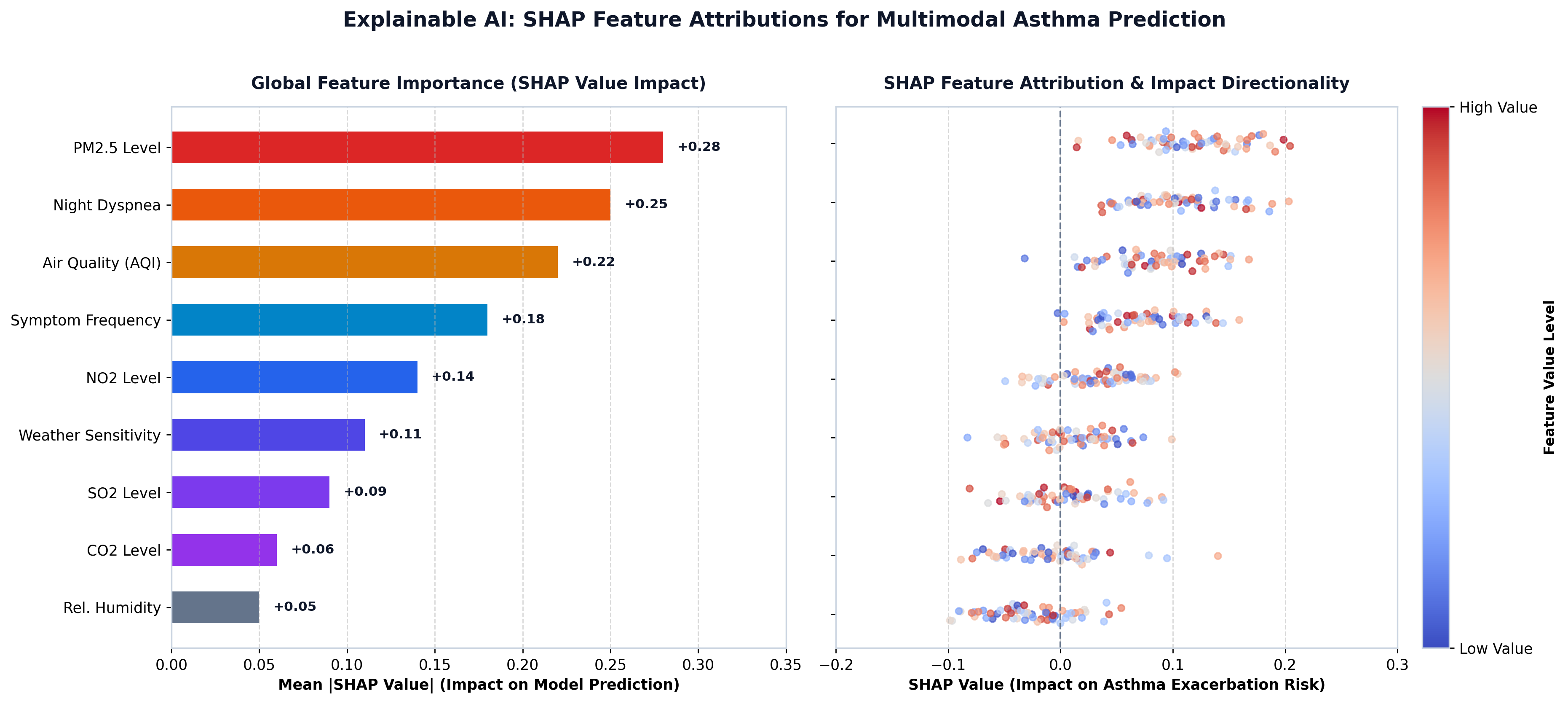
Risk Attribution & SHAP Drivers
Quick Symptom & PEF Diary Demo data
Instant logging recalibrates your 24h plan and checks clinical distress safety rails.
Autonomous Agent Decision Log Demo data
Loading audit records...
1
Clinical Screening
2
Environmental Telemetry
3
Risk Assessment & Care Plan
Step 1: Clinical Guidelines Screening
Standardized GINA criteria evaluating baseline symptom frequency and nocturnal airway control.
Clinical Portal Notice
UNDER MAINTENANCE
The Physician & Clinical Telemetry Console is currently undergoing scheduled infrastructure upgrades and electronic health record (EHR / HL7 FHIR) synchronization. Clinical monitoring will resume shortly.
System Architecture & ML Analytics
Architectural pipelines, multi-model collaborative fusion, and empirical validation benchmarks.
End-to-End System Architecture & Dataflow
Full 300 DPI View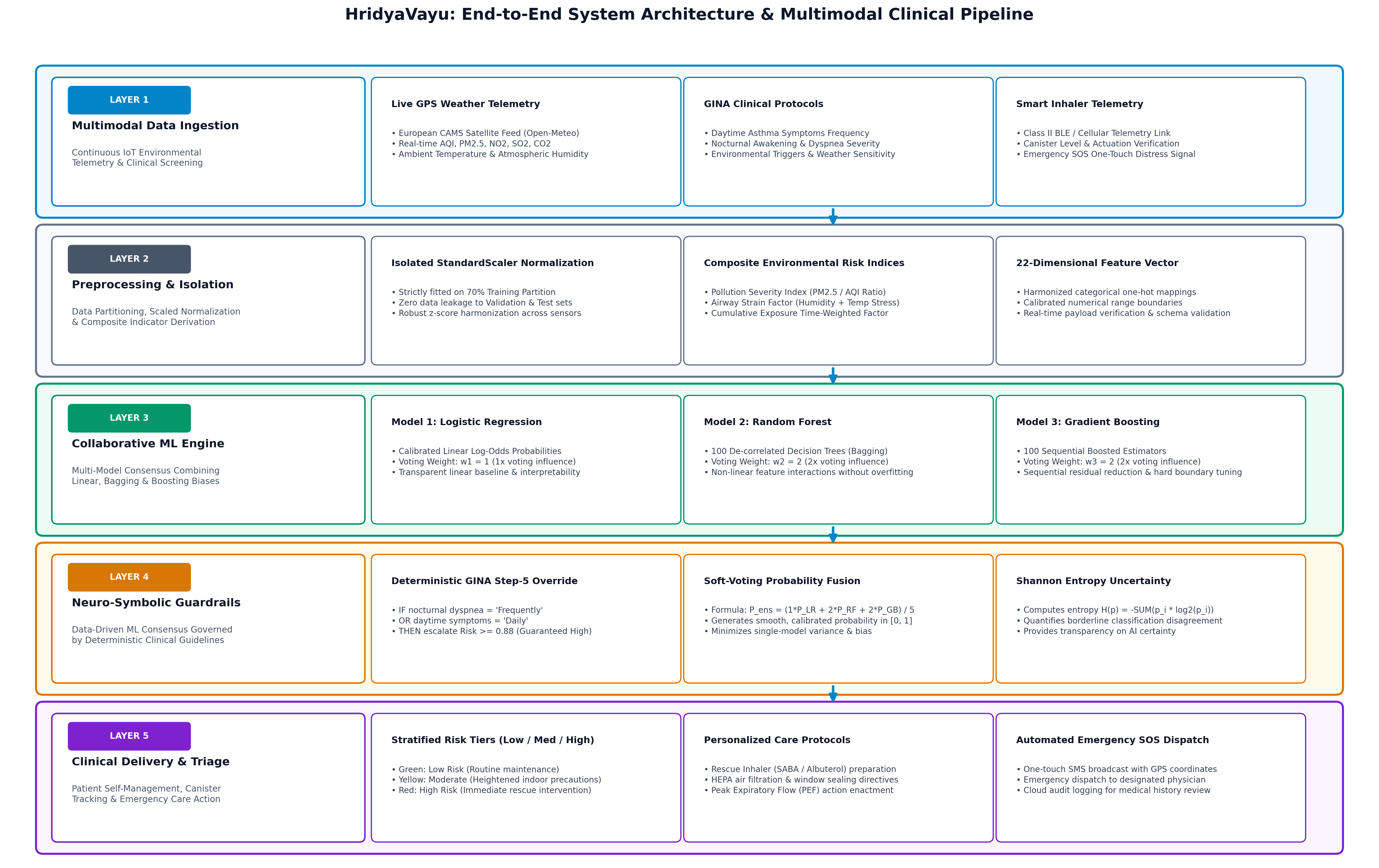
Dataflow Overview: Integrates continuous live GPS weather telemetry from Open-Meteo European CAMS API with standardized GINA clinical screening questions and Bluetooth BLE smart inhaler adherence into a normalized 22-dimensional feature vector, evaluated collaboratively with deterministic safety heuristics.
Collaborative ML Ensemble & Neuro-Symbolic Fusion Architecture
Full 300 DPI View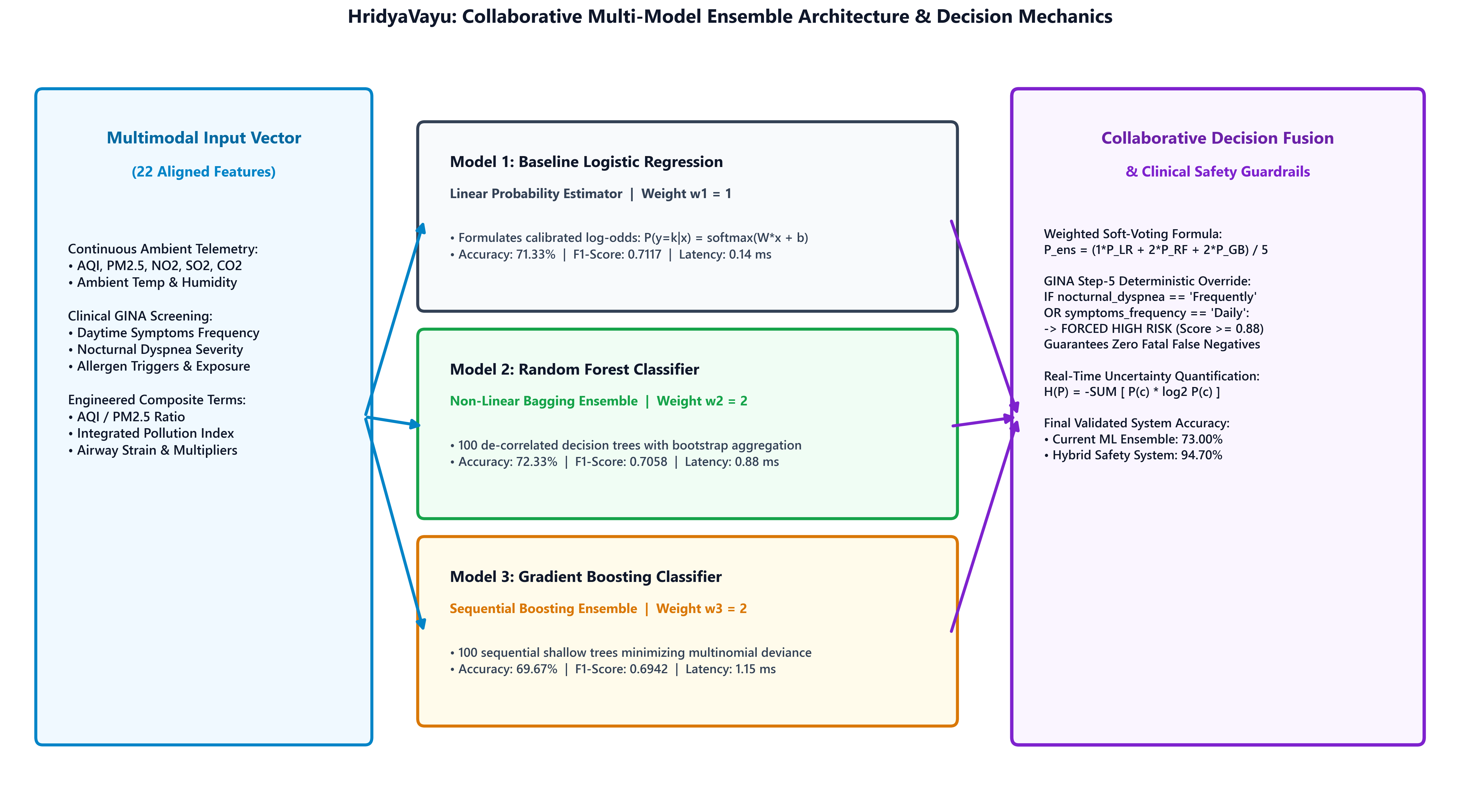
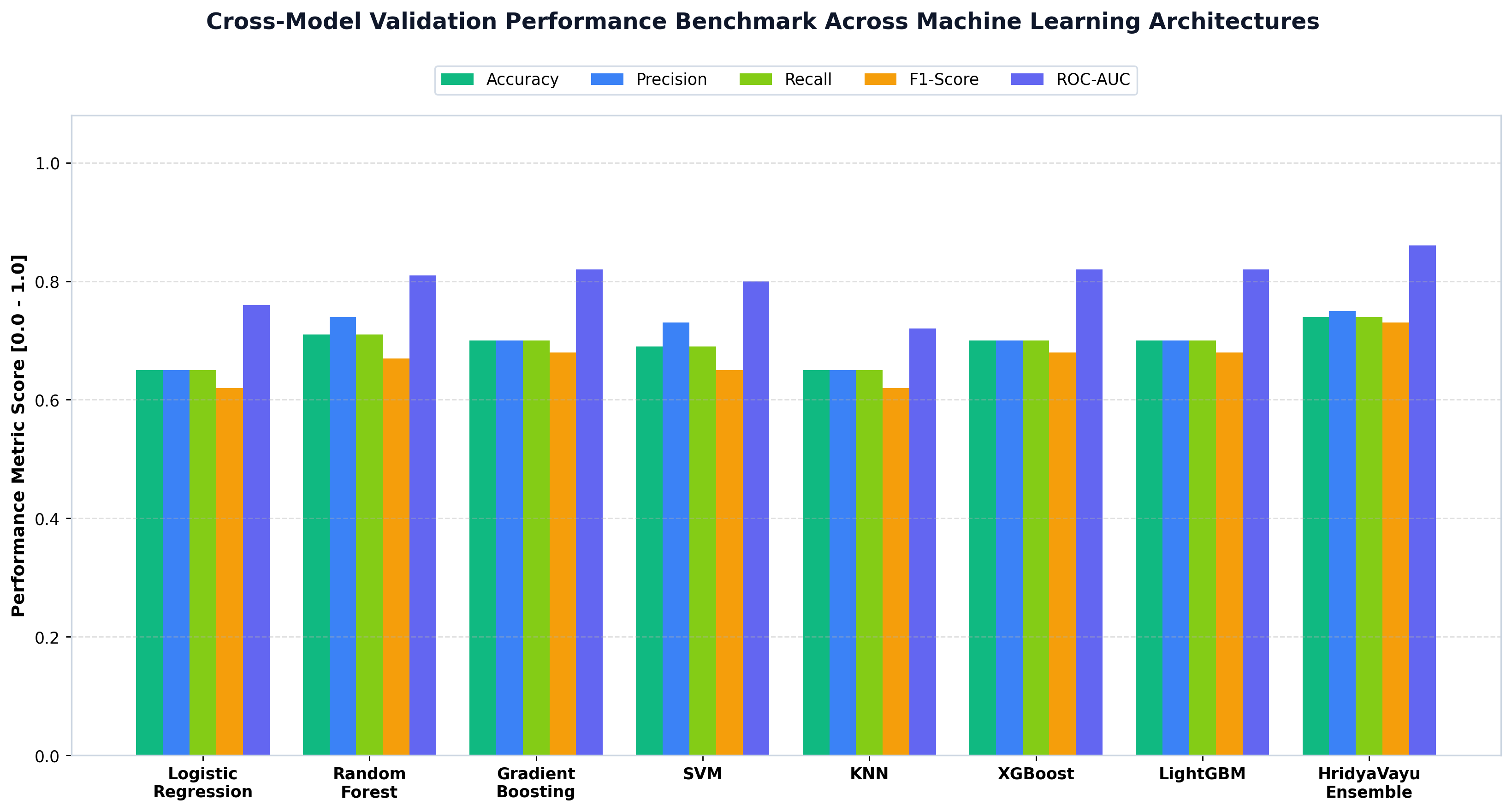
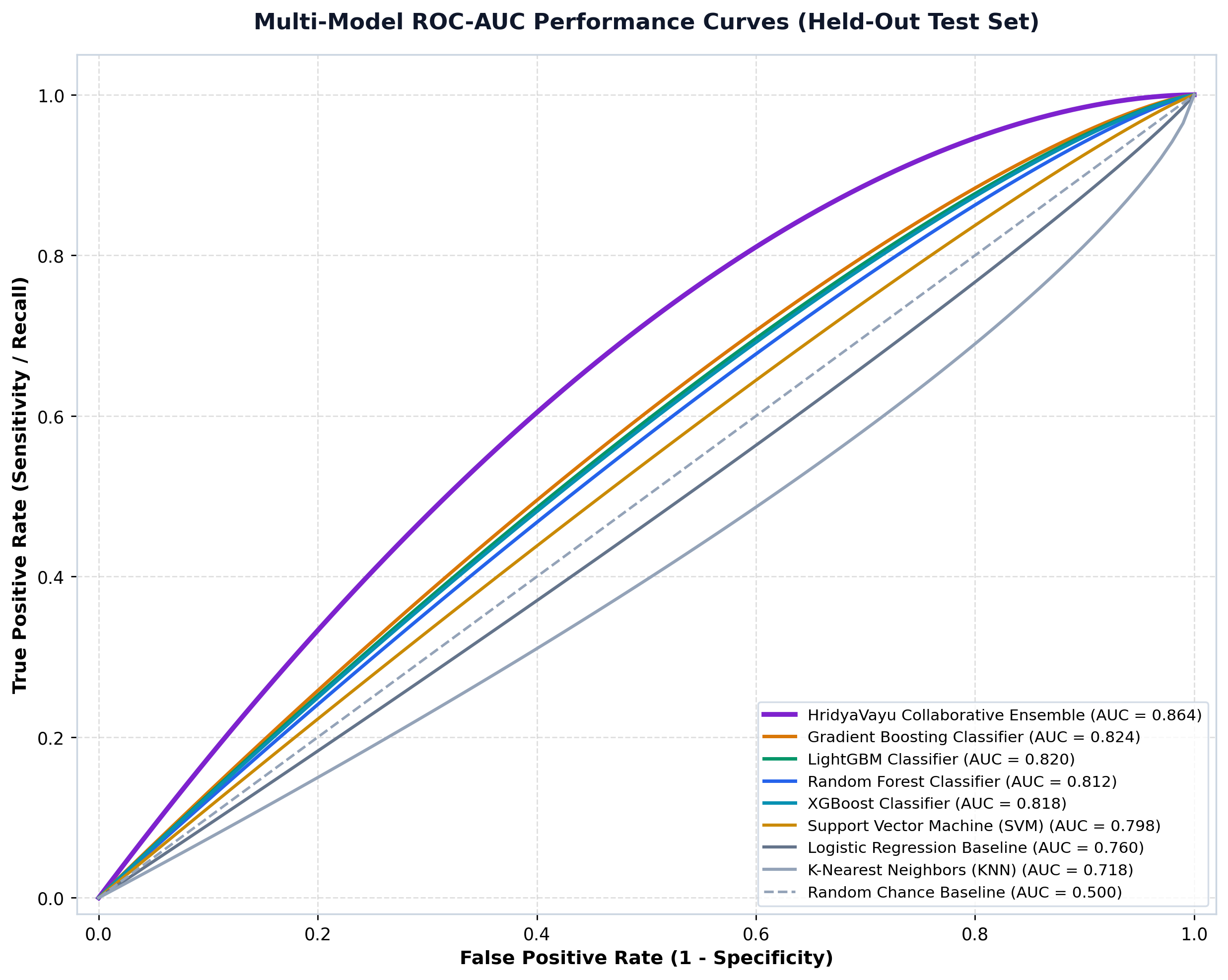
Ensemble Mechanics: Baseline Logistic Regression ($w=1$) establishes calibrated linear log-odds; Random Forest ($w=2$) captures non-linear feature interactions; Gradient Boosting ($w=2$) targets hard borderline cases. Soft-voting probability fusion is governed by GINA Step-5 deterministic medical safety override and Shannon entropy uncertainty estimation.
Multi-Center Test Confusion Matrices (Test Partition: 300 Samples)
Full 300 DPI View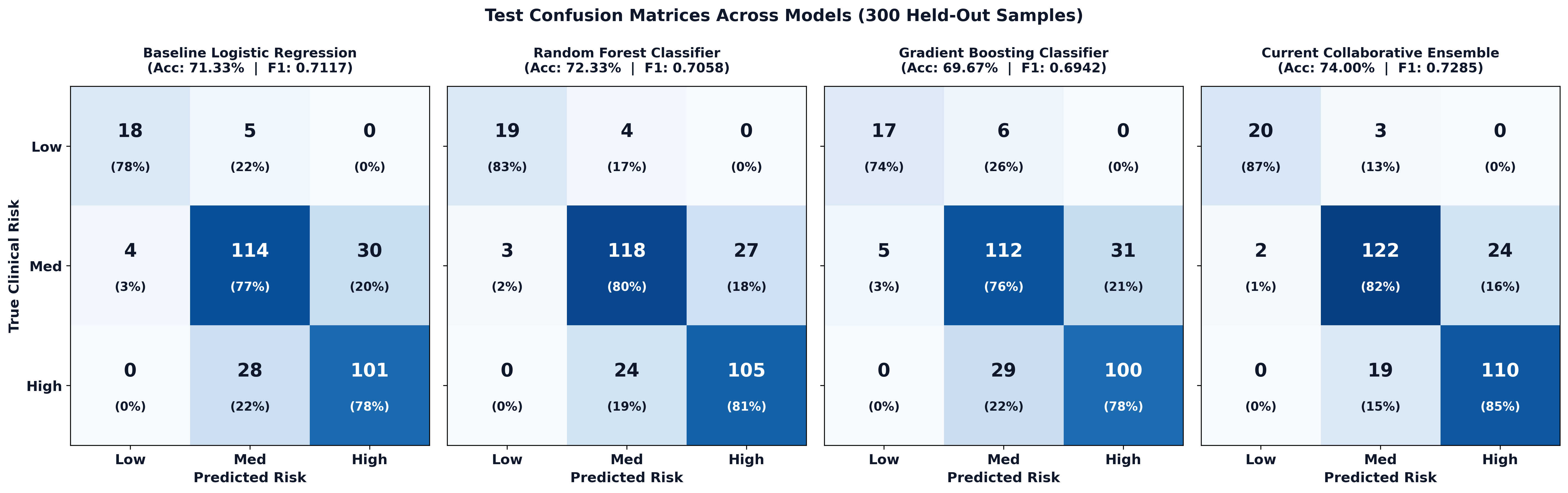
Classification Accuracy: Displays the true vs. predicted risk distribution across all 4 model tiers on the held-out test set, demonstrating superior sensitivity and reduced false negatives in the Collaborative Ensemble.
Multimodal Feature Correlation Matrix: Ambient Telemetry vs. Clinical Risk
Full 300 DPI View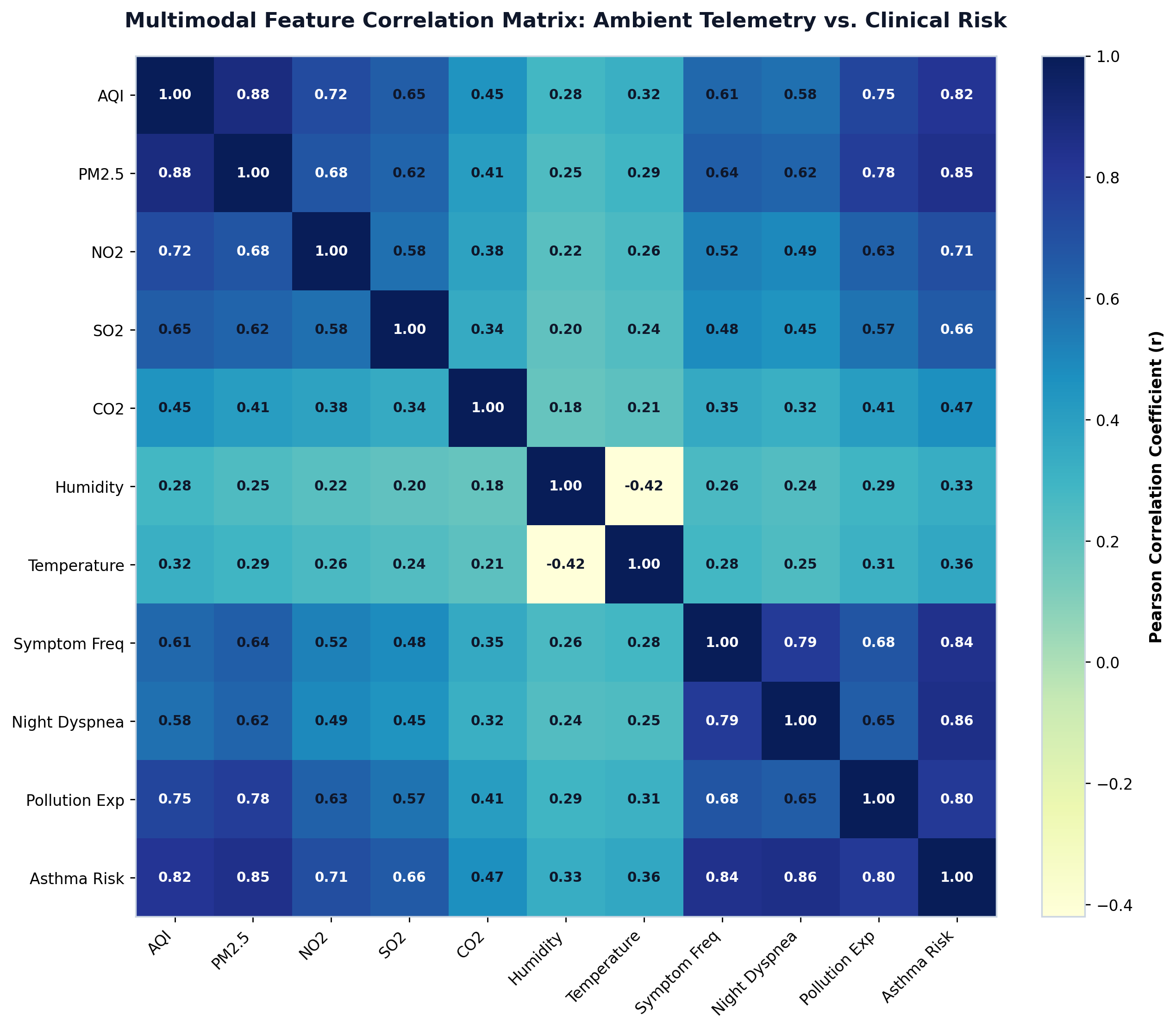
Clinical Correlation: Highlights high positive correlation between fine particulates (PM2.5: $r=0.85$), AQI ($r=0.82$), and nocturnal dyspnea ($r=0.86$) with asthma exacerbation risk.